
latest
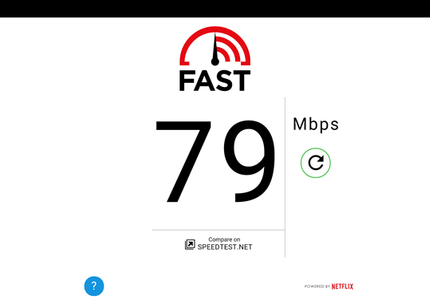

Fast, smooth data download speed is kind of important to mobile video, especially now that even mid-range Android phones are rocking 1080p screens. That's part of the reason that Netflix created FAST.com, its own branded alternative to web speed tests like Ookla's SpeedTest.net, back in May. The idea is to make sure you're getting an accurate test across multiple services (there's even a SpeedTest.net link right on the page) and your internet service provider isn't throttling your connection.


CloudMagic isn't a new app, but people are constantly on the lookout for an alternative to default Gmail app that, for various reasons, doesn't meet their needs. If you personally need an email client that can support multiple accounts spread across different sites, something with lightning fast search, and something that doesn't make your eyes bleed, CloudMagic may just be the free app you've been looking for.


Have you heard of TransferJet? We won't begrudge you if you haven't. It's a fairly obscure bit of technology that hasn't managed to work its way into many consumer products, despite first launching to the public back in 2008. So, consider this whole article a bit of indulgent dreaming when we tell you about Toshiba's newly-announced micro-USB adapter that can add TransferJet capabilities to Android phones. What does that mean? Well, it means 560Mbps transfers between devices with a tap. To put it another way: you could easily send 250MB worth of data from one handset to another in the time it takes to read this sentence (or about 70MB/sec).


Looking to give users the "fastest, smartest launcher for Android," Jesse Andersen brought Conjure to the Play Store recently. The app, which is actually more of a launcher companion, can perform an incredible range of actions, from finding and launching apps to calling contacts, adjusting device settings (like volume, Wi-Fi, Bluetooth, etc.), and searching the web.

Verizon 4G LTE Coming To 33 New Markets And Expanding in 32 Existing Markets On July 19th
You know what time it is: time for Big Red to light up some new areas with its hyperfast 4G LTE network. The lucky ones this month: El Dorado/Magnolia

You know what time it is: time for Big Red to light up some new areas with its hyperfast 4G LTE network. The lucky ones this month:

How many times have you thought to yourself 'you know, I have this super-fast device on a super-fast LTE connection, but my SD card is just too slow'? Even if you've never actually had that thought cross your mind, Samsung has an answer to this quandary: microSD cards that are four times faster than the current high-end cards.


Yesterday, HTC dropped a teaser on their Facebook page: a vector outline of a phone with an HTC logo and a big "5" in the center and a caption of "This Sunday you'll discover something fast." With 5 days to go until MWC began, we took a few stabs at what it could mean. Today, the company has followed up with a "4" teaser image on their Facebook, with the caption of "This Sunday, you'll hear something authentic."


Last night, I sent out a message from our social accounts praising the Epic 4G Touch's boot times. They amazed me as soon as I turned this Galaxy S II Sprint variant for the first time last Friday and haven't ceased to amaze me ever since. I have loaded up all the same apps and then some compared to any of my other phones, and still - the Epic 4G Touch blazes by the competition like no other device I've seen.

It's hard not to love SetCPU developer Michael Huang. He's been on the overclocking frontline for many devices, including the Samsung Galaxy S II and Motorola XOOM, and now he strikes again with an custom tweaked kernel (update: to clarify, the kernel source isn't available, so this isn't a rewritten kernel - he used a hex editor to modify it) for the HTC EVO 3D that allows for a stable 1.8GHz. With a few minor tweaks the kernel should work for the Sensation as well, although he hasn't had time to get it working without a device in hand.

The title pretty much says it all, but I'll explain this quick tip in a bit more detail. All too often I want to jump into the Market on my phone and search for an app I already have in mind. However, before the search box even appears, I am forced to wait for the featured app screen to finish loading, which on slow connections can take ages.

If you liked my speedy QR code tips before, you're going to love the tip I have for you today. Ever since the Android web Market was launched, I found myself loading the homepage just to make a search approximately 17 million times a day, give or take a few. As you know, the web Market homepage is quite heavy, so loading it just to make a search, especially while tethering on a slow connection, was starting to get kind of annoying.

Today, U.S. Cellular announced that it would be bringing 4G LTE services to about a quarter of its customer base in certain areas of Iowa, Maine, North Carolina, Oklahoma, Texas, and Wisconsin before the holiday season this year. Some of the cities that will be included in this initial rollout are Milwaukee, Madison, and Racine in Wisconsin; Des Moines, Cedar Rapids, and Davenport, Iowa; Portland and Bangor, Maine; and Greenville, North Carolina.

One of the few tech blogs who managed to get their hands on Motorola's upcoming AT&T flagship - the Atrix 4G - is, of course, Engadget. The reviewer, unsurprisingly, is the infamous cool geek and editor-in-chief Joshua Topolsky, who, from my experience reading Engadget's reviews, does a good overall job but fails to go into those details that matter to most Android users. The Atrix 4G review is exactly what I had expected, and I'm going to summarize it and save you 20 minutes reading it.

In today's Android-enabled world, QR codes play quite an important role because, face it, who wants to type that long, pesky URL on your phone's keyboard when you can just quickly scan an image and have the URL decoded in a split second?

Many of you are complaining about Android 2.1, even though Sprint is well within the promised June timeline.
As I recently started downloading and listening to lots of podcasts, I found that my Hero's 2GB MicroSD card filled up literally overnight.2GB is such a measly number that disgracing the Hero with it any longer was a blow to both mine and its pride, so I headed over to Amazon to find a new faster, higher capacity storage card.After careful deliberation and weighing all pros and cons, I ended up picking the A-Data Turbo 16GB Class 6 MicroSD card.