
latest
Here's how to get the Pixel 4a's Eclipse live wallpaper on any phone
If you like bluish gradients, this is your wallpaper

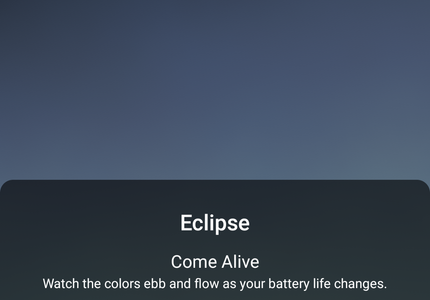
It's pretty common for wallpapers from the latest phones to be ported to others, and the Pixel 4a is the latest subject of this. A developer on the XDA Forums by the name of Pranav Pandey has ported the 4a's Eclipse live wallpaper, and we have the download over at APK Mirror.

[Update: Name likely Oreo] Google has an Android O event on August 21st to coincide with the eclipse

Read update
- Based on the filename for a video Google recently posted via Google+ (GoogleOreo_Teaser_0817_noDroids (1).mp4), odds are high the next release of Android will be given the name Oreo.
Today it has been revealed that Android O, the next major version of Google's operating system, will be "touching down" (and likely shown off) on August 21st at 2:40 PM ET via a livestreamed event from New York City. The wait is nearly over. In just a few more days those of us with supported devices might even be enjoying the latest and greatest release of Android. But at a minimum, we should know a lot more about it.


Long ago in days of yore, Google provided a plugin for the popular Eclipse integrated development environment, the better for aspiring mobile devs to work with their favorite IDE while making new apps. Months after the release of the stand-alone Android Studio version 2.2, Google is officially getting rid of support for the older IDE in favor of its own internal project. To be clear, Eclipse is still very much alive and in active development (it's not a Google program), it's just the plugin that's no longer supported.


It's been a long and winding road, but the days of Eclipse with ADT are over. In a post on the Android development blog, Google has announced that development and official support for the Android Development Tools plugin for Eclipse will be shut down at the end of this year. Google intends to focus all of its effort on improving Android Studio and advises developers move their active projects to Android Studio using the included migration tool.

A couple of weeks ago, a release candidate for Android Studio 1.0 rolled out to the Canary development channel to allow users a chance to poke and prod at it before an official launch. The serious issues have been worked out and Android Studio has been given its first official release to the stable channel. Alongside the title change, Android Studio has also been declared the "official Android IDE." ADT with Eclipse is still available, but is no longer considered to be in active development.

Google Working On New Android Build System To Replace, Unify Eclipse's ADT And Ant – Devs Can Try It Now
Google Working On New Android Build System

Looking to create a more versatile and powerful build system for Android developers, Google has been working on what is currently called "New Build System," a tool that aims to (one day) replace, unify, and build upon the functionality of Eclipse's ADT and Ant build systems.

[Update: Winners!] Book Giveaway: Win One Of Ten Copies Of Android Apps With Eclipse
[warning] The contest is now over. Here are the winners, selected at random: Danny Holyoake Zhe Xi Ooi Marc Zdon Dennis F Heffernan

There are a lot of integrated development environments out there, and when it comes to Android, Eclipse is one of the most popular. As always, Apress has every budding developer's back with a book written specifically for getting people up and running on the IDE. The book is called Android Apps with Eclipse, and it covers everything from installing and configuring Eclipse to finalizing and tweaking your app.

[Video] Android Developer Gold: Multi-Configuration Editing, Along With Numerous New Improvements, Coming Soon To Android Developers' Tools
The Android developers' tools team, headed by the usual suspects Xavier Ducrohet and Tor Norbye, led a session at I/O 2012 today dedicated to improvements

The Android developers' tools team, headed by the usual suspects Xavier Ducrohet and Tor Norbye, led a session at I/O 2012 today dedicated to improvements and new features coming to the tools devs use to make apps - ADT for Eclipse and SDK Tools.


In a Bluetooth SIG listing (a trade certification group), LG has officially confirmed the existence of the E970 and LS970. The former is possibly headed for AT&T (it has AT&T GSM and LTE bands - which could mean Rogers as well) and is packing a quad-core Qualcomm S4 Krait chip, complete with the latest Adreno 320 GPU goes toe-for-toe with the Galaxy SIII in GLBencmark. The 1280x768 resolution is something of an oddity - why the extra 48 pixels? A 13MP rear camera and 2GB of RAM round of this beefy device's specs. It's actually quite similar to the upcoming Optimus LTE2, so we could be seeing a carrier-specific iteration of that hardware here.

As an Android developer, the first thing I do when I set up Eclipse with ADT on a new machine is hunt down the Android source for the API level I'm working on.

To help Android developers automate some things and catch certain errors early on, the Android Tools team is pushing ahead with a new dev tool called Android Lint. Android Lint will be available in the next release of ADT (16) and Tools (r16).

The Android 4.0 API that was released together with the unveiling of the Galaxy Nexus also brought us, developers, ADT 14 and SDK Tools r14, which quite a few people started having problems with almost immediately. The tools were released in an incomplete state based on my experience with ADT 14-preview, as some serious and known bugs weren't fixed when 14-final came out. I have a feeling the ICS event kind forced the corresponding ADT/tools 14 release and prompted Google to roll it out in what I consider a broken state (many reported crashes, broken Logcat, etc).

We, Android developers, spend our days staring at a computer screen, most likely at one of Eclipse's windows. Eclipse is an amazing IDE in theory, but it never quite feels complete and polished, mostly due to the fact that it's powered by open source enthusiasts and is based almost entirely on plugins (if you want to get it to do anything useful, that is).

The moment we've been waiting for so many months - it's finally here! I can hardly contain my excitement as I'm writing this, but both Gingerbread and the Samsung Nexus S were officially announced 30 minutes ago. As expected, the new OS bears the version number 2.3 and brings updates to the SDK and the NDK as well SDK tools and the Eclipse ADT plugin.

I was browsing the Android commit tree, as I like to do at 3:20am sometimes, and I just saw a new commit by Tor Norbye with the following description that made my heart skip a beat: "Add autoformatting of XML." This little update may not mean much to the regular folks, but to Android developers, like myself, this has been a long requested feature.


As you may have heard, LG has big plans for a little Android smartphone called Eclipse/LU2300. The company has not really done a whole lot with Android thus far, so it’s good to see them starting to make a serious smartphone that runs Android.

